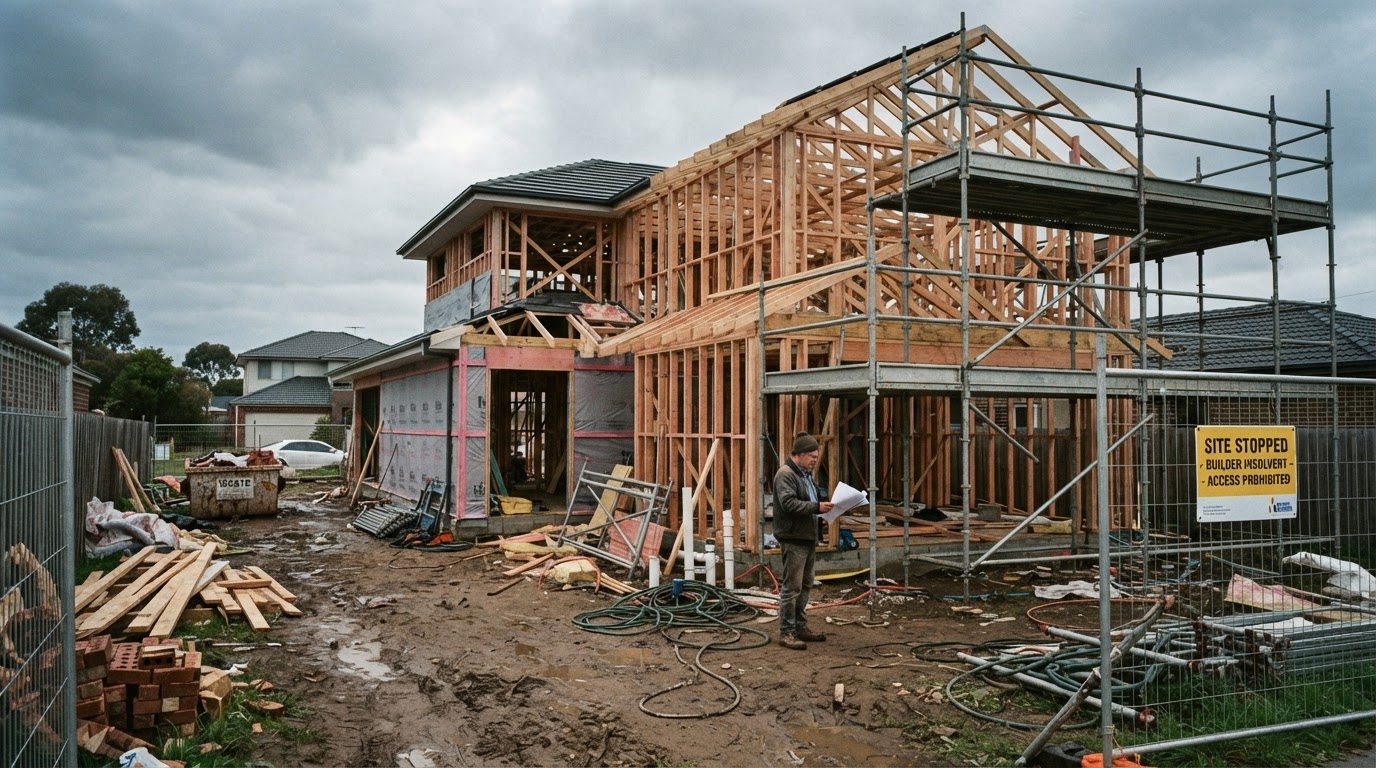
When a builder goes bankrupt mid-project, your home build stops, your deposit and progress payments are at risk, and your contract does not automatically end, the classic builder bankrupt scenario. This guide from Find Select Buy walks through exactly what happens if a builder goes bankrupt, from the first phone call to the final insurance claim.
Builder insolvency is when a building company can no longer pay its debts as they fall due. It is a financial state, not a single event. The company may still be trading while insolvent, which is why the warning signs matter.
Three terms get used loosely. They are not the same thing:
- Administration: an independent administrator takes control to try to save the company or sell it.
- Liquidation: the company is wound up and a liquidator sells assets to pay creditors.
- Bankruptcy: a personal legal status for an individual, not a company.
Most building companies enter administration or liquidation, not bankruptcy in the strict sense. The practical result for you is similar: work stops and money is exposed.
- ASIC's insolvency guidance for consumers
How to Check If a Builder Is Insolvent Before You Sign
You can check a builder's financial health before you sign anything. Do it every time, even for a builder a friend recommends.
Here is how to check a builder's financial standing:
- Search the company name on the ASIC registers for current status and any external administration notices.
- Ask for their domestic building insurance certificate and confirm it covers your project.
- Request their builder registration number and verify it with your state building regulator.
- Ask for two recent completed projects and call those owners.
- Check whether they are named in any current tribunal or court disputes.
Warning Signs Mid-Project
The most common mistake when a builder bankrupt risk is building is ignoring a pattern of small delays. Watch for requests to pay ahead of schedule, subcontractors asking you directly about unpaid invoices, sudden staff turnover, and trades walking off site. Any one of these is a prompt to act, not wait.
First 24 Hours, First Week, First Months: A Time-Ordered Checklist
This section is sequenced so you can work through the steps in order. Work top to bottom. The order matters because some actions preserve rights that later actions depend on.
First 24 hours: preserve evidence and stop the bleeding
The goal in the first day is not to solve the problem. It is to make sure nothing you do now weakens your position later.
- Open an insurance claim reference before you know whether you have a claim. Call your domestic building insurer and ask for a reference number and the name of the assessor who will handle it. A reference number gives you a single point of contact for the claim. Do not wait for the administrator to confirm the insolvency in writing.
- Photograph and video the entire site in one continuous pass. Walk the block filming from the street to the rear boundary, then photograph each elevation, each room, stacked materials, delivered fixtures, temporary fencing, services connections and any visible defects. Include a shot of a newspaper or phone screen showing the date. This is the evidence that later proves what existed on the day work stopped.
- Secure keys, locks and site access. Change or rekey site locks if you hold the authority to do so, retrieve keys from the supervisor, and confirm who now controls the site. An unfinished site is a safety hazard and an insurance liability.
- Put everything in writing to the builder and the administrator. Email the builder, the appointed administrator or liquidator, and your lender in one message. State the date work stopped, ask for their written position on the contract, and ask who is responsible for site security. Keep the email, a written record of when you notified each party is often the difference between a claim accepted and a claim disputed.
Watch out: paying a subcontractor or supplier directly in the first 24 hours to "keep them on site" can be treated as a new contract and may complicate your insurance claim. Get advice before any payment.
First week: build the file and get an independent number
By the end of week one you should be able to hand an assessor a complete file and a defensible cost to complete.
- Assemble the contract file in one folder. Contract, signed variations, plans, specifications, the progress payment schedule, every invoice, bank statements showing each payment, and all correspondence including text messages. Insurers assess on documents, not on recollection.
- Commission an independent cost-to-complete quote. Ask a registered builder who has not worked on the project to quote the cost to finish the remaining scope and to separately price rectification of defective work. Get the quote in writing with a scope breakdown, not a lump sum.
- Notify your lender in writing if you have a construction loan. Progress payments stop when work stops, and your lender needs to know before the next drawdown is scheduled. Ask what they require before releasing further funds to a replacement builder.
- Get legal advice on termination before you send any notice. The contract usually survives insolvency, and terminating incorrectly can be treated as your breach. A short advice session on your termination clause is cheaper than defending a wrongful termination claim.
Following months: claim, decide, transfer
The months after the initial shock are about converting evidence into money and deciding how the project finishes.
- Lodge the full insurance claim with the complete evidence file. Do not lodge piecemeal. A complete first lodgement reduces the back-and-forth that eats into claim deadlines.
- Decide whether to continue with a replacement builder or stop. Compare the cost-to-complete quote plus rectification against the insurance payout and your remaining budget. Sometimes completing is cheaper than stopping, and sometimes it is not.
- Transfer warranties, approvals and certificates into your name where possible. Ask your state regulator what is required for a replacement builder to take over existing approvals, and keep a written record of every certificate issued before the insolvency.
- Keep a running log of every call, email and meeting. Date, who you spoke to, what was said, what was promised. If the matter ends up in a tribunal or with a dispute resolution body, a contemporaneous log is persuasive evidence.
Your Building Contract and Unfinished Building Work After Builder Insolvency
Your contract usually survives the insolvency, but the builder cannot perform it. That leaves you holding a binding agreement with a company that cannot finish the job.
Can You Terminate the Contract and Hire a Replacement Builder?
Yes, in most cases, but the process matters. Check your contract for a termination clause covering insolvency, then issue written notice. Do not simply walk away, because that can be treated as your breach.
Unfinished building work after builder insolvency needs an independent assessment before you sign with anyone new. Get the scope, defects and remaining cost documented in writing.
Domestic Building Insurance and Builder Insolvency Claims
Domestic building insurance is the main financial safety net when a builder becomes insolvent before completion. It is not automatic, it is not unlimited, and it does not cover everything you have lost. Understanding how the cover is structured is what turns a stressful situation into a claim you can actually run.
What the cover typically responds to
Domestic building insurance schemes and their terms vary by jurisdiction. Confirm the cover on your own policy certificate and with your state or territory regulator, which will set out what the policy responds to.
Eligibility: the three tests that decide most claims
Most declined claims fail on one of three points, not on the insolvency itself.
- Was the policy in place before work started? If the builder never took out the required cover, or took it out after commencing, the insurer may decline. Check the certificate date against your contract start date.
- Was the work within the insured scope? Owner-builder work, some commercial mixed-use projects and work below the threshold may fall outside the scheme.
- Was the loss caused by the insolvency, or by something excluded? Defects that existed and were known before the policy period, or damage caused by your own actions, are commonly excluded.
Deadlines: the clock starts earlier than most people think
Deadlines differ by scheme. Confirm the notification and claim dates in writing with your insurer at the first call, and diarise them.
Coverage limits: what the cap actually means
The policy limit is a cap on the insurer's liability and is not a guaranteed payout. Ask your insurer for the limit in writing. If your cost to complete plus rectification exceeds the cap, the excess is your loss and you rank as an unsecured creditor for it. Ask your insurer for the limit in writing and compare it against your independent cost-to-complete quote before you decide whether to complete or stop.
Where to claim, by jurisdiction
Rules are set by state and territory, so the scheme, the limit and the deadline that apply to you depend on where the work is. Confirm with your own regulator rather than relying on a national summary:
Rules are set by state and territory. Confirm the scheme, limit and deadline that apply to your work with your own state or territory building regulator before assuming you are covered.
- Victorian Managed Insurance Authority on domestic building insurance
What the insurer will ask you for
Expect the assessor to ask for the contract, the insurance certificate, proof of payments, an independent cost-to-complete quote, site photographs and evidence of the insolvency. Lodging these together is generally helpful. Keep copies of everything you send.
Get advice before accepting any settlement from an administrator or liquidator or signing any release.
Documenting the Project and Calculating Your Cost to Complete
Your claim and your recovery both depend on records. Build a single folder now.
- Contract, plans, specifications and all variations
- Every invoice and proof of payment
- Progress payment schedule and receipts
- Photos of completed work and defects
- Correspondence with the builder and administrator
Then calculate your cost to complete. Get two independent quotes for the remaining work, add rectification costs for defective work, and subtract any insurance payout. That figure is your real exposure.
Subcontractors, Suppliers, Warranties and Building Approvals
Subcontractors and suppliers are usually unsecured creditors. They may place liens or stop work, and some will contact you directly. Do not pay them separately without legal advice, as it can affect your claim.
Warranties and building approvals need care. Statutory warranty periods generally continue, but you must be able to show the work was done. Confirm with your regulator that approvals and certificates remain valid before a replacement builder takes over.
Check Your Options Before You Build
The best protection against builder insolvency is choosing the right builder before you sign. At Find Select Buy, our complimentary buyers advocate service gives you access to 20 builders and 35 lenders, with 100% fixed-price turnkey homes and one dedicated advisor from enquiry to handover.
Book your quick home ownership review call to get a free personalised review of your situation. You can also book a free new home guidance call with our team, or review the simple steps in ways to move closer to a new home.
Frequently Asked Questions
What happens to my building contract if my builder goes bankrupt?
When a builder enters liquidation or administration, the contract usually ends or can be terminated for breach. An administrator may continue trading briefly, but a liquidator typically winds the company up. You should stop progress payments, get legal advice on termination, and check whether domestic building insurance covers the unfinished work. Keep every contract document, invoice and payment record, because the insurer or liquidator will ask for them.
Can I get my deposit back if my builder becomes insolvent?
Recovering a deposit from an insolvent builder is difficult. In liquidation, unsecured creditors such as homeowners usually rank behind secured creditors and employees, so returns are often minimal. Domestic building insurance may respond to a loss of deposit depending on the scheme; confirm with your insurer and regulator. Lodge a proof of debt with the liquidator and an insurance claim as early as possible, and keep payment evidence ready.
Does domestic building insurance cover a builder going bankrupt?
Domestic building insurance, also called home warranty insurance, is designed to cover loss when a builder dies, disappears or becomes insolvent before or during construction. Cover, claim limits and deadlines differ by state and territory. Check your insurance certificate, contact the insurer promptly, and confirm eligibility with your state building regulator before assuming you are covered.
Should I keep making progress payments if my builder is in financial difficulty?
Stop paying once you have credible evidence of insolvency or administration, unless a legal or insurance adviser tells you otherwise. Paying an insolvent builder can increase your financial loss and complicate an insurance claim. Ask for written confirmation of the company's status, secure the site, and document completed work against payments already made. Only resume payments to a replacement builder under a new contract, ideally with your insurer's approval.
Builder insolvency is stressful, but it is survivable when you act fast and document everything. Get started with Find Select Buy and build with a vetted builder on a fixed-price contract, so a financial shock never lands on your doorstep.
Ready to Find Out If You Can Own Instead?
Take our free 2-minute check to explore low deposit new home options matched to your income and situation.